SmarTrip is something that WMATA riders are very familiar with. It’s how we’ve been paying for Metro rides for more than 25 years.
However, with the rise of open payment and Tap.Ride.Go being implemented this year, the idea of the physical farecard may be in jeopardy. Below is a look at the history of SmarTrip, an overview of Tap.Ride.Go, commemorative farecards, and what transit systems may be able to do to keep public transit from becoming completely utilitarian.
History of SmarTrip
1975 – The $54 million contract for Metro’s fare collection system (which resulted in the magnetic stripe paper ticket) was awarded in 1975 to Cubic Transportation Systems
May 18, 1999 – WMATA and Cubic Transportation Systems’ SmarTrip was introduced, which was the first contactless smart card for transit in the United States. At this time, it’s only good for rail and parking.
November 12, 2002 – Metrobus customers have the option of paying their fares with SmarTrip cards.
August 9, 2004 – All Metrobuses are now equipped with SmarTrip
May 18, 2005 – Metro celebrates the sale of the one millionth SmarTrip card
April 2, 2007 – Parking facilities at Anacostia, Vienna, Franconia-Springfield, New Carrollton, Shady Grove, and Largo Town Center begin accepting major credit cards as payment in addition to SmarTrip cards
January 6, 2008 – Fares on Metrorail and Metrobus increase, but customers using SmarTrip cards receive a discount
November 2008 – CVS starts selling SmarTrip cards in 187 D.C. locations. This was an effort to increase SmarTrip use and make it easier for people who exclusively use the bus to get a card
January 4, 2009 – Metro discontinues use of paper transfers. Only riders paying with SmarTrip® can transfer free from one bus to another.
July 2010 – Metro riders can now view their SmarTrip card transactions online. Any requests for SmarTrip data under the previous policy were provided in hard copy.
September 2010 – Metro needs new farecards because the company (Giesecke & Devrient) that made SmarTrip cards stopped producing the cards and retained proprietary ownership. WMATA stockpiled 350,000 cards to last them two years.
September 22, 2011 – Metro launches SmarTrip Online Reload, after missing the original launch date in September 2009
January 9, 2014 – WMATA awards a $184 million contract to Accenture to replace existing fare collection systems for open payment. However, the contract was later cancelled.
Dec 3, 2015 – Metro reaches “paperless” milestone; all fare machines now selling SmarTrip® only. The last stations to receive the upgraded fare machines were Anacostia and Naylor Road.
March 6, 2016 – Paper farecards are no longer accepted. Riders with remaining balances on paper farecards are able to transfer the balances over to a SmarTrip card.
January 2018 – SmarTrip cards no longer permit negative balances. Previously, riders could leave the metro system with a negative balance, they just had to reload their card before riding again
May 10, 2018 – CVS threatens to stop selling and reloading SmarTrip cards, citing operational challenges in stores. The crisis is averted on May 15, 2018
September 1, 2020 – Apple and WMATA enabled SmarTrip cards to be added to Apple Pay through the Wallet app. Google Pay on Android phones quickly follow on June 8, 2021.
March 1, 2022 – Cards purchased before 2012 are no longer accepted. New faregate receptors are incompatible with pre-2012 SmarTrip card technology.
January 2023 – Metro announces “Metro Report”, which gives users a summary of their metro activity over the past year. Overall, there were 226 million trips across rail, bus, and MetroAccess.
November 2024 – WMATA chooses LittlePay over incumbent Cubic for the “Open-Payment Overlay”. WMATA aims to have this project completed before World Pride (June 2025)
After consolidating all of these events, I found some common themes. To make it easier to see patterns and how long certain initiatives took, I went ahead and created a timeline.
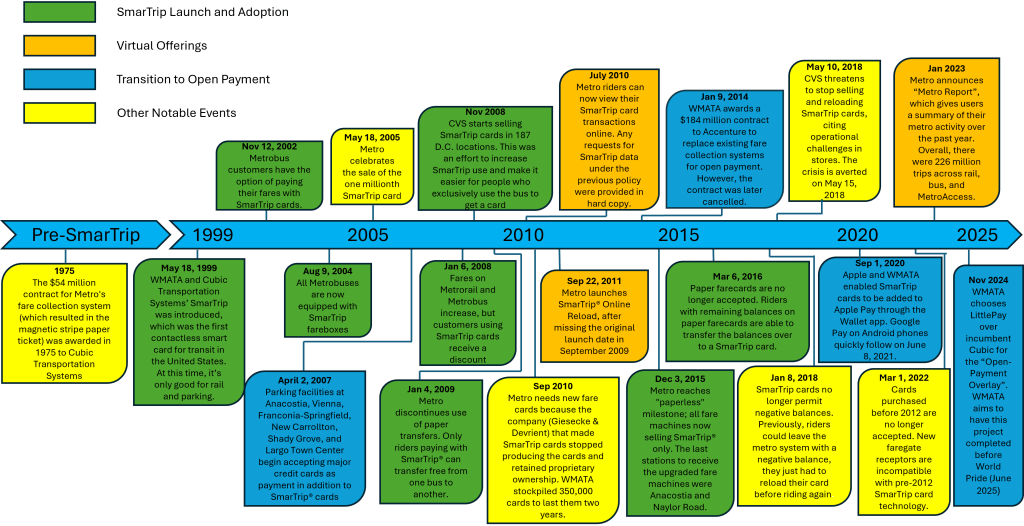
A few of my own takeaways from these events…
- Open payment has been in development longer than many realize. WMATA started accepting credit card payments for parking at select stations in 2007, addressing customer concerns about limited payment options. However, significant advancements toward open payment systems paused until 2014.
- The transition from paper farecards was gradual. In 2009, WMATA discontinued paper transfers, aiming to encourage SmarTrip card usage and reduce costs associated with printing and fraud. Despite this, paper farecards remained in circulation until March 6, 2016, when faregates stopped accepting them.
- The situation with Giesecke & Devrient, WMATA’s farecard supplier, highlighted the importance of foresight. I’m glad WMATA was able to stockpile enough SmarTrip cards until they figured out a solution.
- I think it’s cool that the one millionth SmartTrip card was sold exactly five years after SmarTrip originally launched. What a way to celebrate!
With all of that said, WMATA finally launched open payment on May 28, 2025.
After years of buildup, the launch came and went with surprisingly little communication and excitement. I didn’t learn about it until I was finishing a presentation for my transit enthusiasts group. A whole week after launch when I presented my SmarTrip findings, several group members were genuinely surprised by my announcement that it was already live.
Tap.Ride.Go – An Overview
With the launch of Tap.Ride.Go, riders can now pay their WMATA fare using almost any contactless method. This includes credit and debit cards, Apple Pay, Google Pay, Fitbit and Garmin Pay (which I hadn’t realized existed), and contactless-enabled gift cards. Each rider still needs their own payment method, since the system calculates your fare based on how far you travel.
Here’s my personal pros and cons list on open payment. Keep in mind this is WMATA specific and more open payment capabilities are probably going to be rolled out in the future.
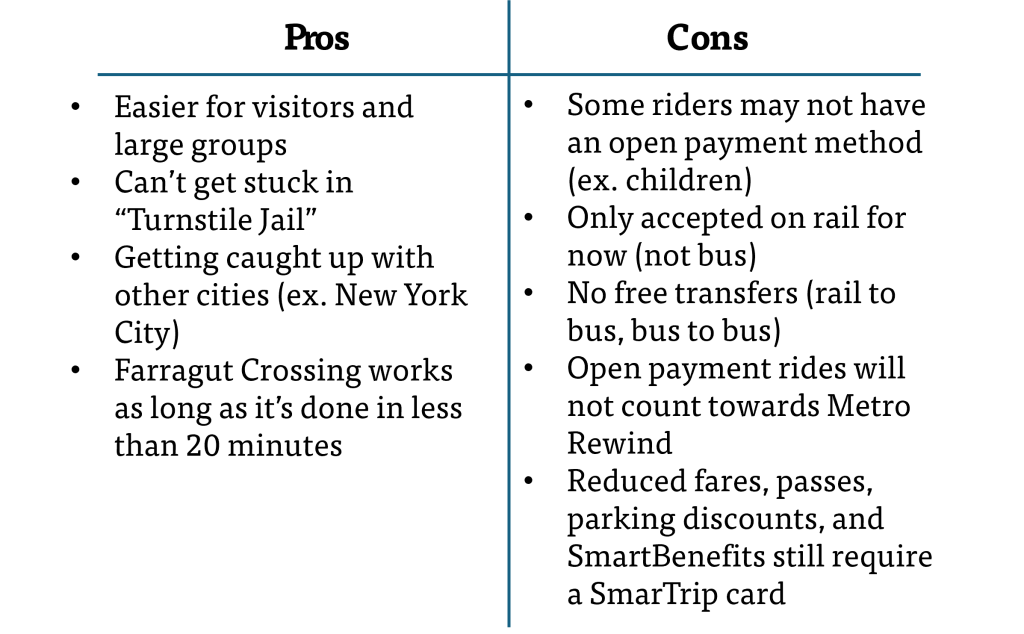
One of my favorite pros is how much easier open payment will make it for visitors and large groups to use the Metro system. Getting your first SmarTrip card can be a little confusing, and that confusion only compounds when there’s multiple people that don’t know what they’re doing. When my family was in town the week before open payment launched, I found myself constantly checking everyone’s balances and helping them reload. At one point, I was reloading cards so quickly the fare machine flagged it as fraud and declined the credit card I’d been using!
Avoiding “Turnstile Jail” (not an official term) is also nice. For those not familar, WMATA has fare machines on the outside of the turnstiles that accept credit and debit cards, but for the longest time, only had fare machines on the inside that only accept change. I’ve noticed that more stations will let you reload your SmarTrip card inside the system using a credit or debit card if you don’t have enough funds on your SmarTrip card to cover the ride, which has been nice. However, I do remember a couple of times where I didn’t have enough funds on my SmarTrip card and I had to scrounge up enough coins to appease the fare machine. I’m assuming that as long as your credit card isn’t declined when you swipe into the system (since I think it pre-authorizes you for the max fare), you can’t get stuck in the system due to insufficient funds.
While Tap.Ride.Go does have tangible benefits, there are some real drawbacks. The biggest one right now in my opinion is that not everyone has access to an open payment method. WMATA has made it clear that SmarTrip isn’t going away anytime soon, but if they ever get rid of it, they’ll need to make sure they still have some way for those without an open payment method to pay their fare.
Functionality is another issue. Tap.Ride.Go isn’t as fully developed or robust as SmarTrip (at least not yet.) I expect open payment will extend to buses soon, but for now, it could be confusing that you can use open payment on Metrorail, but not on Metrobus. Transfers are another area where I assume improvements are coming. I’m not sure how the technology behind it works, but Farragut Crossing still honors rail-to-rail transfers, so that’s a good sign. As long as WMATA delays charging your fare until after all transfers are made, I think they can work out the rest.
And while probably not the most important drawback, my main reason for not switching over to exclusively using my credit card is that fares paid through open payment don’t count towards your Metro Rewind. That’s just not an option for me; I need to know how many trips I took compared to other riders and my Metro archetype (I was a “stop collector” last year).
As attached as I am to my limited edition 2023 Cherry Blossom Festival SmarTrip card, I decided to give open payment a try. After all, WMATA has been working on this for years and it felt almost rude not to try it out on launch week.
So, on Wednesday, May 28, I rode from Navy Yard-Ballpark to Waterfront. It’s only one stop, and I usually walk it, but I needed an excuse to test the system. I tapped in and out with my credit card just like I would with SmarTrip. I was a little nervous when the charge didn’t go through immediately, but it came through about 20 minutes later. The fare was $2.25 (lowest possible rate), and it appeared on my credit card as a charge from WMATA headquarters at L’Enfant Plaza.
Overall, while an exciting and long overdue feature, the actual action of tapping, riding, and going was pretty uneventful. Which, I suppose, is exactly the point.

Back to what we know – The SmarTrip Card
With WMATA’s release of open payment, I thought it might be a good time to take a closer look at the SmarTrip card. Many of us use it every day – but when was the last time you actually took a good look at it?

Please note that some of these figures are based on my best estimates. Landmarks like the U.S. Capitol and Washington Monument were easy to identify, but I wasn’t able to verify the others definitively due to a lack of clear sources.
Here’s my reasoning for the items I had to make some assumptions on:
- The train on the left (possibly based on the Series 4000 car): At first, I thought the train depicted was modeled after the Series 1000 car. However, based on the card’s release date and the timing of WMATA’s fleet updates, it may actually have been drawn after the Series 4000 car. The Series 1000 through 4000 cars share a very similar appearance, so it’s difficult to be certain. Picture here
- The bus on the right (possibly based on the 1997 Orion V): This was the toughest one to identify. Initially, the oldest model I found in my research was the 2001 New Flyer bus (which wasn’t that old when you think about how long WMATA has been running bus services). That didn’t quite line up with the SmarTrip card’s release date, but I considered it because of its boxy shape and the stripe details on its side. Later, while finalizing this write-up, I came across the 1997 Orion V. It was released two years before the SmarTrip card and was in circulation in 1999. Not only is it similarly boxy, but the side and front stripe details match the card’s artwork much more closely. Picture here
- The column on the right (possibly based on the National Capitol Columns): Washington, D.C. has no shortage of columns that look similar to the one on the SmarTrip card, especially on monuments and government buildings. However, the column shown on the SmarTrip card appears to be freestanding, which makes me think it may be referencing the National Capitol Columns at the National Arboretum. Picture here
As you can probably tell, the card that shows up in riders’ Apple Wallets and the Senior SmarTrip card are pretty similar to the original in terms of illustrations.
Why Commemorative Farecards?
Many cities with transit systems release commemorative farecards. These are often made to celebrate national holidays, mark local events, or offer advertising opportunities for businesses and products.
Below are a few quotes from transit professionals explaining why systems choose to issue limited-edition farecards.
“Limited-Edition MetroCards are a fun and unique way for partners or advertisers to reach their audience…MetroCards tend to be refilled, which allows our customers to ride with their favorite limited-edition card well past the timing of a promotion.” – Kayla Shults, MTA Media Liaison & Spokesperson
“Our hope is that these [commemorative] cards allow our riders, and non-riders alike, to get excited about transit, build more support for transit, and celebrate the communities that make San Diego what it is – America’s finest.” – San Francisco MTS, San Francisco’s Transit System
People will pay for “superfluous” items, especially for something that touches their lives daily. Commemorative designs also get people to view transit systems as part of the culture rather than just a utility. – Summarized from Reece Martin
“If you’re looking for a last-minute stocking stuffer, this [the Commemorative Obama Inauguration farecard] would be a wonderful keepsake” – John Catoe, Metro General Manager 2007 – 2010
Commemorative Farecards – WMATA
WMATA has released a number of limited-edition commemorative farecards over the years. While many appear to celebrate regularly scheduled events, others seem to be one-off releases for reasons known only to WMATA.
This is not a comprehensive list of every commemorative farecard WMATA has ever issued. Instead, it’s a selection of my personal favorites and cards that I think best represent the different types WMATA has released.








National Cherry Blossom Festival (Slide 1/9)
WMATA has been releasing limited edition commemorative cards to celebrate the National Cherry Blossom Festival for years. Above are SmarTrip card designs for 2018, 2019, 2022, 2023, 2024, and 2025.
Presidential Inaugurations (Slide 2/9)
Given that Washington, D.C. is the nation’s capital and the site of presidential inaugurations, it makes sense that WMATA releases commemerative SmarTrip cards each time a new president takes office (or at least tries). Above are the SmarTrip card designs for 2009, 2012, 2013, 2017, 2021, and 2025.
- This card was designed before the 2012 election (October 2012). It never went into circulation.
- WMATA designed this card for the 2017 inauguration after reaching out to the Trump campaign for a picture and not receiving a response. A commemorative sleeve with a picture of Trump was produced and distributed along with this card on inauguration day.
- WMATA did not release a card for President Biden’s inauguration because there were no public events and did not want to encourage people to travel to the inauguration because of the pandemic.
National Museum of African American History and Culture Opening (Slide 3/9)
The National Museum of African History and Culture opened in 2016 after 13 years of work. To celebrate the new Smithsonian, WMATA decided to release limited edition SmarTrip cards. Above is the collection of cards that was released.
The Phillips Collection Van Gogh Repetitions Exhibit (Slide 4/9)
The exhibition of Van Gogh paintings was organized by The Phillips Collection and The Cleveland Museum of Art. Above is the collection of cards WMATA released to celebrate.
Pandas/National Zoo (Slide 5/9)
WMATA has frequently celebrated the pandas at the National Zoo by highlighting them on the front of its farecards. Above is the collection of SmarTrip cards released in 2014 to celebrate the 125th birthday of the National Zoo and the SmarTrip card released to celebrate the return of pandas in 2025. Finally, this paper farecard had a couple of pandas on it, which goes to show how popular the animal has been for years.
- This is not a SmarTrip card, but felt relevant to this post because of the pandas
Sports (Slide 6/9)
WMATA has released several commemorative SmarTrip cards to celebrate the various D.C. sports teams. This includes a farecard in 2008 recognizing the Washington Nationals (for exactly what I’m unsure), a farecard in 2018 celebrating the Capitals winning the Stanley Cup, a farecard in 2019 celebrating the Washington Nationals winning the World Series, and a farecard in 2022 recognizing the Washington Spirit winning the NWSL Championship.
40 Years of Metro (Slide 7/9)
WMATA celebrated its 40th anniversary in 2016. To mark the occasion, they released a collection of SmarTrip cards, which included the two above. Left and right
Miscellaneous (Slide 8/9)
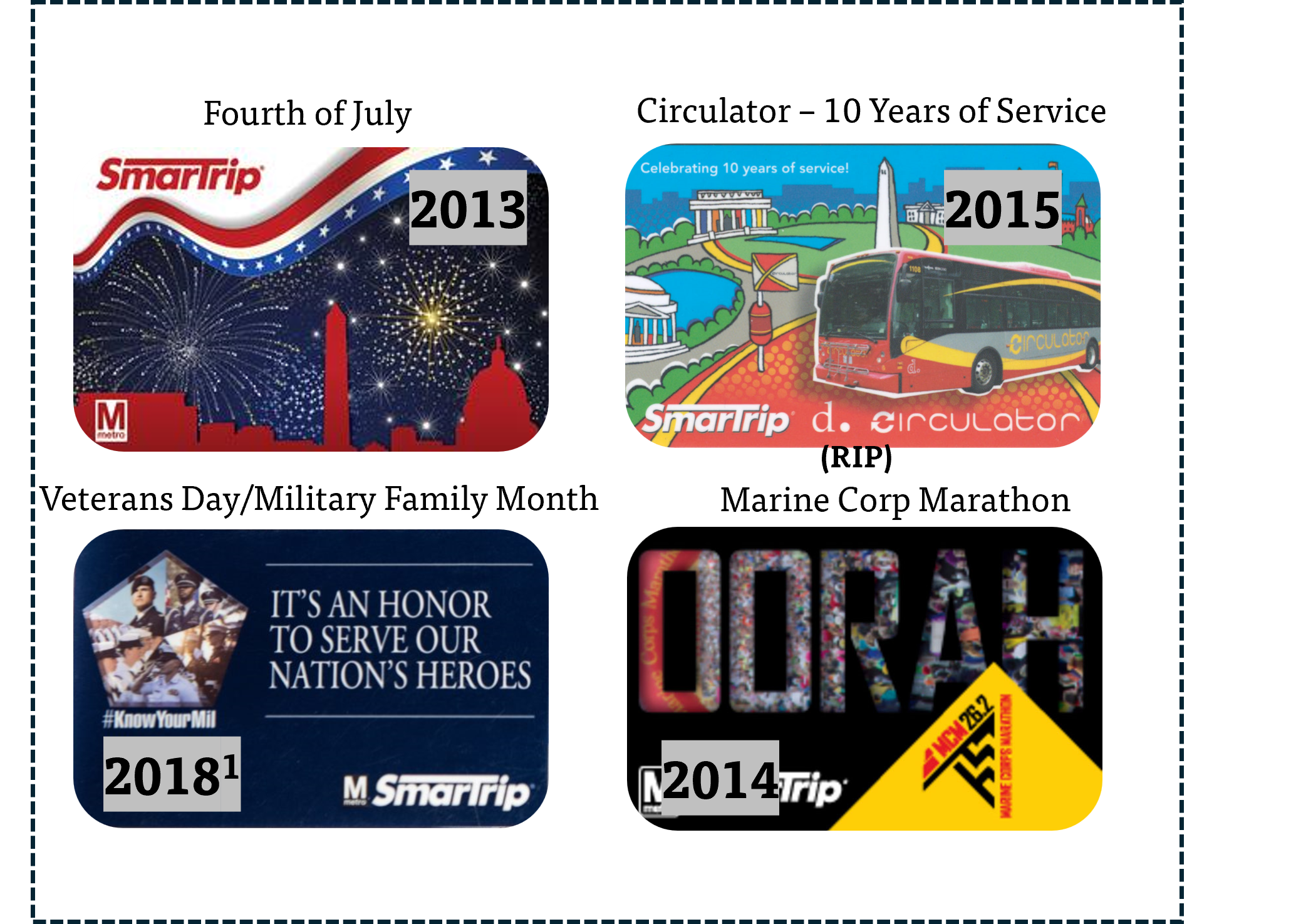
WMATA has chosen to release commemorative SmarTrip cards for occasions it doesn’t usually release one for. This includes a Fourth of July farecard in 2013, a Marine Corps Marathon farecard in 2014, a Circulator 10th birthday farecard in 2015 (RIP), and a farecard for Veterans Day/Military Family Month in 2018.
- This card was originally designed for President Trump’s 2018 Military Parade, which was cancelled in August of that year. However, the card was already developed, so WMATA decided to repurpose them for Veterans Day and Military Family Month in November 2018.
Commemorative Sleeves (Slide 9/9)
WMATA has chosen to release commemorative sleeves in lieu of SmarTrip cards a few times over the years. This includes the commemorative sleeve released for President Trump’s inauguration in 2017 and the sleeve celebrating Pope Francis’ appointment in 2015.
Commemorative Farecards – Other Systems
WMATA is far from the only system to release commemorative farecards. Here are some of my favorites from other systems.

MetroCards
2013 – A year after Superstorm Sandy, MTA highlighted six areas that had been most affected. Those areas included Long Beach, Coney Island, and the Rockaways. This farecard was specifically highlighting the Rockaways
2024 – Depicting the alternative rock band Vampire Weekend, this farecard is part of a tradition by the MTA of issuing limited-edition designs showcasing different artists
One thing I noticed on Metrocards that I didn’t see as often on other farecards was the extensive use of advertisements. While some other systems allow advertisers to sponsor commemorative designs, New York stood out for the sheer number of cards that functioned as ads first and foremost.
TAP Cards
2013 – Farecard released to celebrate the holiday season. I’m not sure what the QR code led people to; unfortunately, it didn’t seem to work when I tried to scan it myself
2018 – One of six “Metro Manners” cards released to remind riders about best practices on public transit. It’s a reminder that’s still very much needed today
ORCA Cards
2024 (Top) – This farecard illustrates Community Transit’s Zip Shuttle, which is an on-demand shared ride service
2024 (Bottom) – Released to celebrate summer and the King County water taxi. It was also the first ORCA card to have a QR code on the back, which when scanned, showed riders water taxi information and schedules
PRESTO Cards
2021 – Farecard designed by Karly Cywink. This was a partnership between Metrolinx and Aexon Group Inc. to provide PRESTO cards to two Toronto Urban Indigenous organizations.
2015 – Celebrated the opening of the UP Expresses, which allows riders to ride between Pearson Airport and downtown Toronto in 25 minutes.
Oyster Cards
2022 – This farecard was released to celebrate the opening of the Elizabeth line in May 2022
2012 – Released to recognize and celebrate the 2012 London Olympics. I can only imagine how important London’s public transit system was to keep traffic at bay during the games
Notes:
- Most of the limited edition designs I saw on the MTA cards were on the back of the card. I just included the front of the card here for continuity/so people would recognize it
- I don’t think these were publicly available, but I really liked the design
MTA Phasing out Physical Cards
As open payment becomes the norm across transit systems in the U.S. and around the world, physical farecards (both standard and commemorative) face an uncertain future. One of the most prominent examples is the MTA’s MetroCard, which is set to be phased out by the end of 2025.
That’s right. After December 31, 2025, the MTA will no longer accept the iconic MetroCards, which have been in circulation since January 1994. Since the introduction of open payment methods (including credit and debit cards, Apple and Google Pay, and OMNY cards), demand for MetroCards has steadily declined. Today, 65 percent of riders use some form of open payment. The MTA says the full transition to open payment will save both riders and the agency time and money. In fact, they expect to save at least $20 million annually by eliminating costs associated with MetroCard production and distribution, vending machine maintenance, and cash handling.
Below are pictures of the first commemorative MetroCard and the final commemorative designs.

Making Digital SmarTrip and Open Payment Fun
One of my gripes with open payment is that it strips away some of the charm and personality from the public transit experience. Tapping a credit card at the turnstile is convenient, but it also makes the interaction feel purely transactional.
As several transit professionals have pointed out, commemorative farecards help make transit feel like more than just a utility by connecting it to the identity and culture of the community. Phasing out these designs means losing a small but meaningful piece of what gives public transit its character.
Since Tap.Ride.Go. is clearly here to stay because of its convenience, I’ve concocted a few ideas to keep the excitement alive in a digital and open-payment world.
As you read through some of my suggestions, please keep in mind that I am not a graphic designer. However, I hope the illustrations give you an idea of what commemorative designs and transit achievements could look like.
#1. Existing Physical Commemorative Cards in SmarTrip and Apple/Google Wallet
I haven’t uploaded my 2023 Cherry Blossom Festival card to Apple Wallet because doing so would deactivate the physical version. I think that makes sense from a technical standpoint, but it also means I wouldn’t be able to show off the design anymore! If it’s possible, these commemorative designs should carry over into digital formats so riders can still enjoy and display them.

#2. Virtual Only Commemorative Card Offerings
As mentioned before, WMATA has said it doesn’t plan to phase out the physical SmarTrip card anytime soon. Still, given what MTA is doing, I don’t think the idea is entirely off the table in the future.
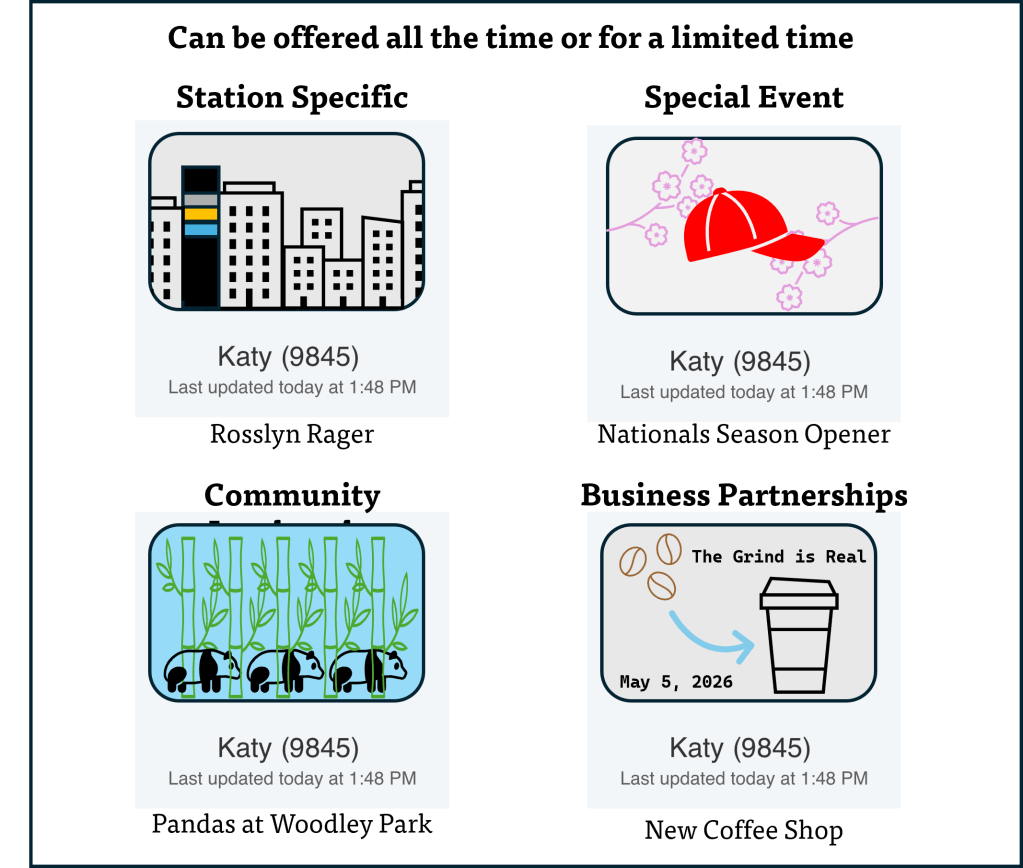
In a completely open-payment WMATA system, users could earn commemorative cards digitally through the SmarTrip app by tapping in or out at specific stations. This would mirror how physical commemorative cards are distributed today, where they’re often only available at select locations. For example, riders could unlock a virtual Nationals Season Opener card by tapping in or out at the Navy Yard–Ballpark station during opening week.
These virtual commemorative cards could also be earned all the time since there wouldn’t be a physical limited stock. For example, if someone is swiping in and out of the Rosslyn station daily because they work in that area, they could earn the Rosslyn Rager commemorative card.
Other ideas include offering virtual-only commemorative cards at community landmarks and allowing advertisers to design their own digital farecards. A Panda virtual card at Woodley Park station, for instance, could be especially popular as pandas have long been featured on WMATA farecards, even before the SmarTrip era.
I think this could be a good addition even while the physical SmarTrip card is in circulation. It doesn’t have to be an either-or situation.
#3 Transit History Tracking and Achievements
I often find myself curious about the number of Metro stations I’ve visited and which ones I frequent the most. While Metro Rewind provides some of this information at the end of each year, it doesn’t offer a comprehensive view, and I have to wait annually for its release. This led me to envision a feature where WMATA tracks and reports to users the stations they’ve visited, which can be seen on the map on the left below.
A system like this could also inform users about the stations they’ve swiped in and out of most frequently, along with visit counts. Building on this, WMATA could award riders with badges (similar to how fitness apps like Apple Watch recognize achievements). For instance, if SmarTrip can monitor station visits, it could grant a badge upon visiting all stations. Other attainable goals might include transferring between rail and bus a certain number of times or enduring a crowded train while trying to get to a Nationals game.

You could even combine #2 and #3 to create commemorative badges riders could earn! This might be ideal if SmarTrip were to go away completely and the idea of a “farecard” is defunct.

Final Thoughts
As WMATA transitions from physical SmarTrip cards to Tap.Ride.Go, riders stand to gain real convenience and flexibility. That said, it’s essential for WMATA to implement the transition thoughtfully to ensure everyone benefits. This includes riders without credit or debit cards and those who rely on senior or discounted SmarTrip cards to access reduced fares
Another important thing WMATA should keep in mind is ensuring public transit doesn’t become completely utilitarian. While I understand at its core transit is meant to get people from point A to point B in a somewhat timely fashion, it’s hard to deny that the Metro is a core part of the community it serves.
Whether you’re a collector of special SmarTrip cards or completely indifferent, I think it’s important to continue looking for those small, but meaningful, public transit moments.
 Commute Curios

Leave a comment